ESSAY
India's Q1 FY27 Earnings: The Real Story The Headlines Missed
4 August 2026
If you read one line about this earnings season, you probably read that profits grew about 9 percent. Weak. Underwhelming. And you scrolled on.
That 9 percent is one of the most misleading numbers in the market right now. Because the moment you understand what is sitting inside it, the whole picture flips. Let me walk you through the season the way an analyst actually reads it, number by number, sector by sector, all the way down to what is quietly powering it. Stay till the end, the last part is the most important, and almost nobody is talking about it.
1. The 9 percent is a trap. The real number is 21.
At the halfway mark of the season, roughly 207 of the Nifty 500 companies had reported. Here is what the aggregate looks like:
Revenue growth: about 19.5 percent. That is one of the highest topline growth rates in twelve quarters. Read that again. Not one of the highest this year, in three years.
Reported profit growth: about 9 percent. This is the number the headlines ran with.
So why the huge gap between 19.5 percent sales growth and 9 percent profit growth? One word: oil.
The oil marketing companies, the HPCLs and BPCLs of the world, had a genuinely terrible quarter, and because they are enormous, their losses drag the entire aggregate down. Strip the OMCs out, and profit growth for the rest of corporate India jumps from 9 percent to about 21 percent.
That is the single most important adjustment in this entire season, and it is why the surface number lies. The typical company is not growing profits at 9 percent. It is growing at 21.
2. The breadth is the real signal, not the headline number
A single aggregate number can be carried by five giants. What separates a real earnings recovery from a fake one is how many companies are participating. This is where Q1 FY27 becomes genuinely rare.
For the first time in twelve quarters, more than 60 percent of reporting companies grew their profits by over 15 percent. The normal range across the last three years has been 45 to 55 percent. So the growth is not narrow, it is broad. Six out of ten companies are firing, not two out of ten.
And when you split the market by size, the result is the opposite of what most people assume. Excluding OMCs:
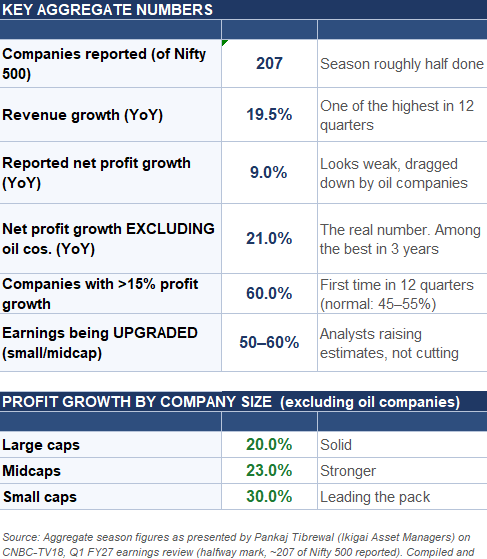
The smallest companies are growing the fastest. And it shows up in analyst behaviour too, earnings estimates are being upgraded, not cut, across 50 to 60 percent of the small and midcap universe. Compare that to a year ago, Q1 FY26, when barely 18 percent of companies were seeing upgrades and growth was concentrated in a handful of heavyweights. The change in one year is dramatic.
3. The one reason behind all of it: pricing power is back
This is the part almost no one is explaining, and it is the real signal for where the market goes next. So slow down here.
For roughly three years, Indian companies were stuck in a strange trap. They were selling more units, but they could not raise prices. Demand was patchy, competition was fierce, and value growth, the rupee value of sales, stayed subdued even when volumes grew. Profits went sideways.
This year, that flipped. Mild inflation has returned to the system, and with it, pricing power. Companies can finally push prices up again. And here is the mechanism that matters:
A company’s costs do not all rise at the same speed as its prices. Rent, salaries, depreciation, interest, these fixed costs stay roughly flat quarter to quarter. So when revenue rises, a big chunk of that extra rupee falls straight to the bottom line. This is called operating leverage. A modest rise in sales becomes an outsized jump in profit.
That is exactly what the numbers are showing. Topline up 19.5 percent, ex-OMC profit up 21 percent. The profit is growing faster than the sales, because operating leverage has finally kicked in after three dead years.
One of India’s most respected fund managers, Pankaj Tibrewal of Ikigai, put it perfectly: inflation is a friend of corporate India right now. That is counterintuitive, everyone fears inflation as a consumer, but for a company with pricing power and fixed costs, it is rocket fuel for margins. This single dynamic is the quiet engine under this entire season, and if it holds, it is the strongest argument for earnings continuing to surprise.
4. What changed in the macro: fear to support, in weeks
Earnings do not happen in a vacuum. A month before this season, the market was scared, of the rupee, of foreign selling, of a weak monsoon. Then three things flipped almost at once.
The rupee got a $40 billion backstop. On 8 June 2026, the RBI opened a special FCNR(B) swap window, letting banks raise foreign currency deposits from NRIs with the RBI absorbing the hedging cost. As of early August, it had already pulled in over $40.8 billion, with the government also scrapping capital gains and interest taxes for foreign investors in government bonds. SBI Research now expects total inflows of $80 to 85 billion by the time the window shuts on 30 September. That stabilised the rupee, and it stopped the foreign selling. In July, FIIs actually turned net buyers.
The monsoon recovered. A rainfall deficit that was running near 40 percent in June collapsed to about 13 percent, with July running above normal. For a country where rural demand still swings on rain, that is a big sentiment and demand shift.
The GST cut lit up autos. Following the GST rate reduction, vehicle sales surged. Tata Motors’ commercial vehicle sales grew about 27 percent, Hero MotoCorp about 23 percent, and Bajaj Auto around 29 percent year on year. When two-wheeler and car volumes move like that, it flows straight into dozens of ancillary companies too.
5. The sector map: where the money is actually being made
Not every sector is winning. This is a market that is rewarding domestic-facing businesses and punishing export-facing ones. Here is the honest split.
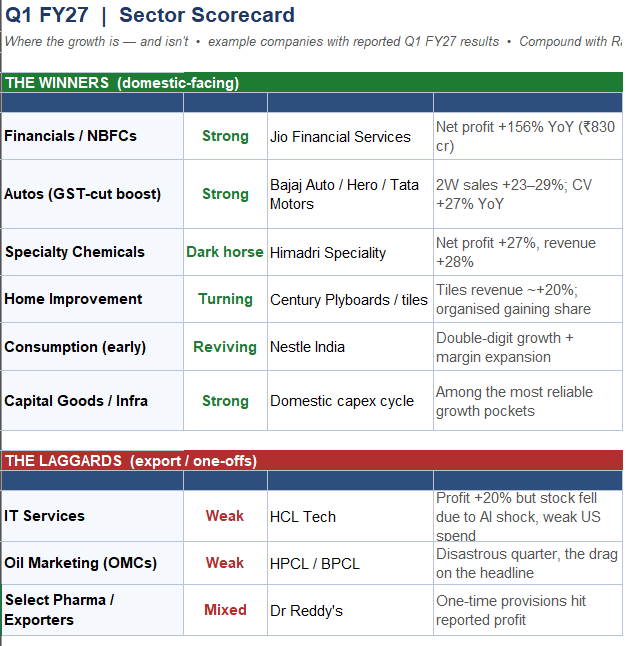
The winners
Financials. The clear engine of the market. Credit growth is strong, and the standout print came from Jio Financial Services, net profit up 156 percent to ₹830 crore. The important nuance from Tibrewal: the large private sector banks have not participated in the rally yet, and he believes the next leg of the Nifty comes from exactly there. That is the space to watch.
Autos and auto ancillaries. The GST-cut beneficiary. Volume growth across two-wheelers and cars is feeding both the OEMs and the parts makers behind them.
Specialty chemicals. Tibrewal’s “dark horse,” and it is delivering. Himadri Speciality Chemical posted profit up 27 percent on revenue up 28 percent, and the broader space reported strong numbers. One honest caveat: part of the strength is being attributed to inventory gains, so watch whether the spreads hold into Q2.
Home improvement, the forgotten theme. Tiles, plywood, pipes. Tiles delivered roughly 20 percent revenue growth, and organised players are grabbing market share from the unorganised sector, a genuine structural shift. The counterpoint to keep you honest: some of this share gain came from a temporary shutdown of unorganised Morbi manufacturers, so it may partly reverse. Century Plyboards is the analyst favourite in the cluster.
Consumption, early signs of life. After years of weak volumes, the early trend is turning. Nestle India reported strong double-digit growth across all four of its product groups with margin expansion, and quick-commerce-led names like Blinkit saw revenue nearly triple. Ground-level demand is finally picking up.
Capital goods, infrastructure and manufacturing. The domestic investment cycle continues to show up as one of the most reliable pockets of growth.
The laggards
IT services. The season’s clear soft spot. Even HCL Tech, which grew profit 20 percent, saw its stock fall, because the sector faces an “AI shock,” weak discretionary spending from US clients, and the risk of guidance cuts. This is where the export headwind bites hardest.
Oil marketing companies. The reason the headline number is depressed. A one-off bad quarter.
Pockets of pharma and other exporters. Some names carried one-time hits, Dr Reddy’s, for instance, took a one-time provision that sank reported earnings.
6. The honest caveats (because this is not all green)
An analyst who only tells you the bull case is a salesman. Here is what tempers the story:
Margins are genuinely under pressure in pockets. Revenue growth is strong almost everywhere, but for several companies, higher costs are keeping profit growth subdued. Operating leverage is helping the leaders, not everyone.
Some of the hottest results carry one-time gains, inventory gains in chemicals, temporary share gains in tiles. Sustainable is different from spectacular.
The market is not cheap. The Nifty trades near 19 times forward earnings, well above emerging-market peers. Good earnings are partly why, but there is little room for disappointment.
The easy money is over. Even the bulls agree the days of buying any small cap and watching it double are gone. This is a stock-picker’s market now, where the winners and losers separate hard.
The season is only halfway done. More large caps report over the coming weeks and can shift the aggregate either way.
7. What to watch from here
Three things will tell you whether this recovery is real or a one-quarter flash:
Do private sector banks finally participate? Tibrewal thinks the next index leg depends on it. Their Q1 numbers and the FII flows into them are the tell.
Does operating leverage hold into Q2? The September quarter also laps a weak base from last year, so on paper it should look strong too. Watch whether margins expand or costs catch up.
Does the FCNR money keep coming? The rupee and FII behaviour hinge on that $80 billion target being met by September.
Bottom line
The headline said 9 percent and the crowd moved on. The reality is a 21 percent ex-oil profit engine, the broadest earnings participation in three years, small caps leading, foreign money returning, and a genuine return of pricing power that is quietly amplifying every rupee of extra sales into outsized profit.
It is not a buy-everything market, margins are uneven, valuations are full, and the easy gains are behind us. But underneath the boring 9 percent that everyone read, corporate India just had one of its strongest, most broad-based quarters in years. That is the story worth understanding, and now you do.
This is educational content only. It is not investment advice, and not a buy, sell or hold recommendation on any stock or sector. Aggregate earnings figures reflect the season at its halfway mark and will evolve as more companies report. Certain figures reflect the analysis of market commentators and brokerages as cited in public interviews and reports. I am NISM certified and not a SEBI registered research analyst. Please do your own research or consult a SEBI registered adviser before investing. Markets carry risk, including the risk of permanent loss of capital.
WANT MORE LIKE THIS?
Join the Inner Circle for weekly deep-dives and live trade calls.
Apply for accessCompound with Raunak is not a SEBI-registered investment adviser. All content published on this platform, including trade calls, research, and analysis, is for educational and informational purposes only. Nothing here constitutes investment advice or a recommendation to buy or sell any security. Readers should consult a qualified financial adviser before making investment decisions. Past performance is not indicative of future results.