ESSAY
MAHAMAYA LIFESCIENCES LTD (BSE SME)
26 March 2026
1. Executive Summary & Investment Thesis
Mahamaya Lifesciences presents a classic dilemma for micro-cap investors: explosive top-line growth and marquee institutional backing versus severe structural cash flow issues. The company is actively transitioning from being an agrochemical formulation importer to establishing its own technical manufacturing capabilities. While recent open-market accumulation by ace investor Vijay Kedia (totaling nearly ₹15 Crores at an average of ₹141) provides a strong sentiment catalyst, my deep dive reveals a balance sheet under immense stress.
The stock is currently priced for perfection. Despite a 34% ROE and revenue crossing ₹264 Crores, the working capital intensity is completely eating up free cash flows. Until I see a structural reduction in inventory days and receivables, the downside risk heavily outweighs the growth narrative.
2. Business Overview & Management Analysis
Mahamaya operates in the agrochemical space, traditionally focusing on generic formulations.
The Pivot: The core bull thesis rests on their IPO capital allocation. They are deploying ~₹29 Crores to set up a new technical manufacturing plant. Manufacturing active ingredients (technicals) rather than just mixing formulations offers higher value addition, better pricing power, and structurally higher margins.
Global Expansion: Management has aggressively expanded its export footprint into markets like Turkey, Egypt, and the UAE, which explains the sudden revenue surge.
Management Execution: While management has successfully scaled the top line, capital allocation efficiency remains unproven. The true test of this management team will be executing the new technical plant without severe cost overruns and clearing out the massive inventory pileup.
3. Industry & Competitive Landscape
The Indian agrochemical sector is currently facing a massive supply glut from China, depressing realization prices across the board.
Competitor Dynamics: As a ₹340 Cr SME, Mahamaya competes with mid-tier players like India Pesticides, Heranba Industries, and Astec Lifesciences. These established peers already have integrated technical-to-formulation capacities and economies of scale.
The Moat: Currently, Mahamaya has a very narrow moat. They are highly dependent on raw material imports and domestic monsoon cycles. The transition to technicals will improve their competitive standing, but they are entering an already crowded and fiercely competitive segment.
4. Fundamental & Financial Analysis
This is where the cracks in the growth story become visible.
Income Statement (The Good): Growth is undeniably explosive. FY25 revenues hit ₹264 Crores (up from ₹162 Crores in FY24). Operating margins expanded to ~9%, driving net profits to roughly ₹13 Crores.
Balance Sheet (The Red Flags): * Working Capital Trap: Receivables ballooned to ₹48.4 Crores, and inventory sits at a massive ₹100 Crores. The company is recording accounting profits but is completely cash-strapped.
Leverage: Total debt is around ₹58 Crores. Against an equity base of ~₹49 Crores, the Debt-to-Equity ratio is over 1.1x. High leverage combined with slow-moving inventory is a toxic mix in a cyclical industry.
Cash Flow: Cash Flow from Operations (CFO) was negative ₹23 Crores last year and barely scratched positive ₹1 Crore recently. Factoring in the capex for the new plant, Free Cash Flow (FCF) is deeply negative.
5. Valuation Deep Dive (DCF Analysis)
To find the intrinsic value, I built a 5-year Discounted Cash Flow model. To give the company the benefit of the doubt, I modeled a highly optimistic scenario where the new plant comes online flawlessly, margins hold, and free cash flows scale aggressively from ₹10 Crores to ₹45 Crores over the next 5 years.
Discount Rate (Cost of Equity): 15% (Standard for high-risk SME micro-caps)
Terminal Growth Rate: 4%
Net Debt: ~₹54 Crores
Total Outstanding Shares: 2.34 Crores
Even with these aggressive growth assumptions, the Present Value of Future Cash Flows + Terminal Value yields an Enterprise Value of ~₹293 Crores. Deducting the net debt leaves an Equity Value of ~₹239 Crores.
Intrinsic Value: ~₹102 per share. At the current market price of ₹148, the stock is trading at a massive premium to its fundamental value, offering absolutely zero margin of safety.
6. Technical Analysis
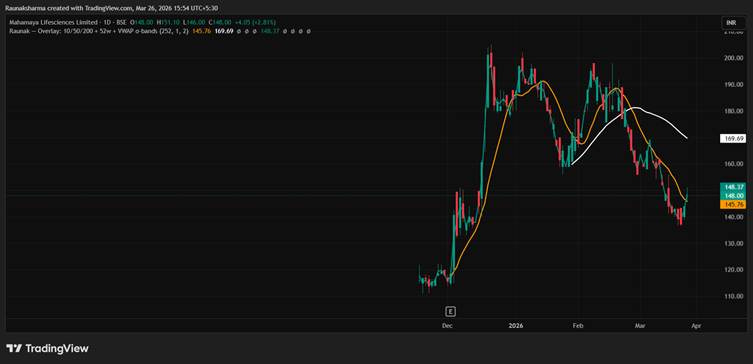
The technical setup reflects the battle between fundamental distribution and recent news-driven accumulation.
Trend Context: After a euphoric post-IPO run peaking above ₹200 in early 2026, the stock entered a severe sequence of lower highs and lower lows.
Support & Resistance: The price recently found a hard floor in the ₹135 - ₹140 demand zone. This perfectly aligns with Vijay Kedia’s accumulation average price of ₹141.02. This acts as a massive psychological and technical support.
Moving Averages: * The stock is currently trading at ₹148.00, having just managed to cross back above the shorter-term orange moving average (₹145.76), indicating a slight shift in short-term momentum.
However, it remains firmly below the longer-term white moving average (₹169.69), which will act as formidable overhead resistance.
Chart Verdict: The stock is currently in a “dead cat bounce” or early consolidation phase. A definitive trend reversal requires a high-volume breakout and sustained close above the ₹170 level. Until then, it is range-bound between ₹140 (support) and ₹170 (resistance).
7. Final Verdict & Actionable Strategy
As an analyst, I respect the institutional momentum, but my capital protection rules prevent me from chasing this.
Mahamaya Lifesciences is a high-risk, high-reward turnaround play. If the management successfully executes the technical plant and drastically improves working capital days, this could be a multi-bagger. However, if the agrochemical cycle turns or debt servicing becomes an issue, the downside is severe.
My Strategy: Avoid deploying fresh capital at ₹148. I will keep this on my watchlist and wait for either:
A severe market correction bringing the price closer to my intrinsic value of ₹100-₹105.
Two consecutive quarters of balance sheet improvement (specifically a reduction in inventory and receivable days) to validate the cash flow turnaround.
Disclaimer: I am a NISM-certified Research Analyst. This report is for educational and informational purposes only and does not constitute direct financial advice. Please consult with a registered financial advisor before executing trades.
WANT MORE LIKE THIS?
Join the Inner Circle for weekly deep-dives and live trade calls.
Apply for accessCompound with Raunak is not a SEBI-registered investment adviser. All content published on this platform, including trade calls, research, and analysis, is for educational and informational purposes only. Nothing here constitutes investment advice or a recommendation to buy or sell any security. Readers should consult a qualified financial adviser before making investment decisions. Past performance is not indicative of future results.