ESSAY
The ₹1.1 Crore "Signal Buy": A Complete Breakdown of TANFAC Industries
24 March 2026
When a company reports a massive 55% drop in quarterly profits, retail investors usually hit the panic button. And that is exactly what happened recently with TANFAC Industries (NSE: TANFACIND). The stock took a beating, and the crowd rushed to the exit.
But while retail was selling, one of India’s most respected ace investors, Ashish Kacholia, did the exact opposite. He deployed another ₹1.1 Crore in fresh cash to increase his total stake in the company to 1.71%. This correction in the stock may continue as it is no where a cheap stock, and the technical price action represents a topping structure in place.
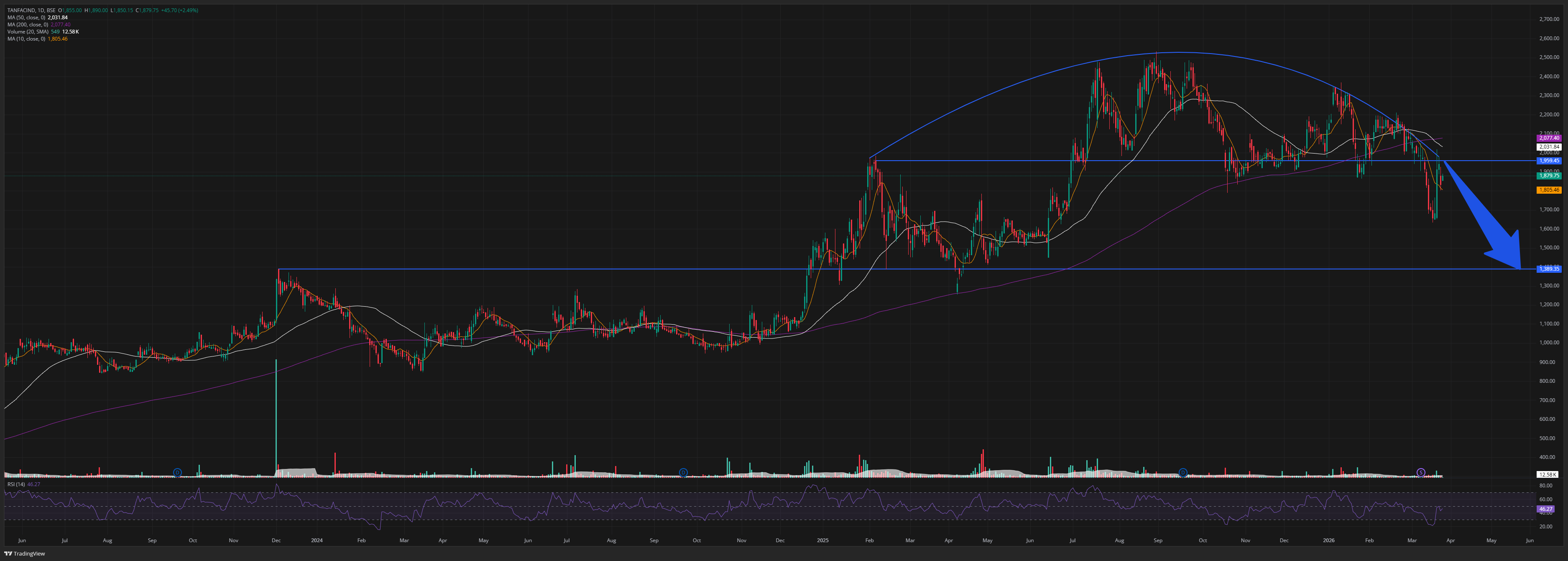
For a whale like him, ₹1.1 Crore is pocket change. But in the investing world, adding fresh capital to a bleeding position is what I call a “Conviction Signal.” It tells the market that the bad news is temporary, and the real growth is just about to begin.
Today, I am going to break down exactly what Ashish Kacholia sees in this chemical company, the massive contracts they just signed, how they stack up against the competition, and the terrifying “Equity Dilution Trap” you need to watch out for.
1. The Business & The Heavyweight Backing
Before diving into the numbers, it helps to know who is running the show. TANFAC is not a standalone operation trying to figure things out in the dark. It is a joint venture backed by the Tamil Nadu Industrial Development Corporation (TIDCO) and the chemical heavyweight Anupam Rasayan India.
They specialize in fluorinated chemicals. In simple terms, these are highly specialized building-block chemicals that are absolutely essential for manufacturing everything from pharmaceuticals to agrochemicals. Having Anupam Rasayan as a promoter gives TANFAC access to world-class R&D and massive client networks.
2. The Growth Catalysts
The 55% profit drop in Q3 (down to ₹15.57 Crores) wasn’t because the business is fundamentally failing. It was largely due to a temporary plant shutdown for annual maintenance, combined with a sudden spike in raw material costs.
The smart money isn’t looking at last quarter’s shutdown. They are looking at the next seven years. Here is the actual growth pipeline that triggered the signal buy:
The Japanese Mega-Contract: In early 2026, TANFAC quietly locked in a colossal 7-year supply agreement with an undisclosed Japanese giant. This deal is for 7,500 metric tonnes per annum and is valued at a staggering ₹2,362 Crores.
The Domestic Win: Alongside the international deal, they also secured a ₹336 Crore domestic contract directly from Krishna Organics.
The ₹495 Crore Expansion: To handle all this new business, the board just approved a massive ₹495 Crore capital expenditure to build a brand new downstream chemical facility at their Cuddalore site. This will add 20,000 tonnes of high-margin capacity by late 2026.
3. Valuations & The Competition
How does TANFAC stack up against the rest of the chemical sector? The fluorochemical space in India is dominated by massive giants like SRF, Navin Fluorine, and Gujarat Fluorochemicals (GFL).
While industry leaders like SRF and Navin Fluorine often trade at premium Price-to-Earnings (P/E) multiples of 50x to 70x because of their massive scale, TANFAC is currently trading at a trailing P/E of roughly 45x.
It isn’t exactly dirt cheap. However, considering the massive revenue visibility from the new ₹2,362 Crore Japanese contract, the market is starting to price in a serious turnaround. With Anupam Rasayan steering the ship, TANFAC is slowly transforming from a smaller, volatile player into a serious mid-cap contender that can eventually compete for market share against the big boys.
4. The Dark Side: Fundamental Risks
This is where retail investors often get trapped. A “Signal Buy” from an ace investor is a great starting point for a case study, but I never invest without looking at the red flags. Here are the three massive risks you have to consider:
⚠️ Risk 1: The ₹500 Crore Equity Dilution Trap Building a new ₹495 Crore plant requires serious cash. To fund this, the board recently approved a ₹500 Crore fundraise via a Qualified Institutional Placement (QIP), alongside a 1:2 stock split. Issuing millions of new shares will instantly dilute the ownership of existing retail investors. This suppresses the Earnings Per Share (EPS) and can keep the stock price moving sideways—or even down—until the new plant actually goes live.
📉 Risk 2: Severe Input Cost Volatility Chemical companies have very little pricing power when raw material costs spike. TANFAC’s Q3 operating margins collapsed from roughly 28% down to 15% because the cost of hydrofluoric acid shot up. If commodity prices stay high, their bottom-line profits will continue to bleed, no matter how big their order book gets.
🏗️ Risk 3: Execution Delays The new Cuddalore plant is slated for completion in late 2026. Infrastructure projects are notorious for delays. If they miss their deadlines, their capital gets trapped, the new revenue gets pushed back, and the market will punish the stock price.
5. The Final Verdict
TANFAC Industries is a classic high-risk, high-reward turnaround story. The revenue visibility for the next decade is practically locked in, and the backing of Anupam Rasayan provides a strong institutional safety net. Ashish Kacholia’s recent ₹1.1 Crore top-up proves that the smart money is willing to wait out the current margin pressures.
However, the upcoming ₹500 Crore equity dilution is a massive near-term hurdle. If you are tracking this stock, the game plan is simple: watch the raw material costs closely over the next two quarters, and track how the market absorbs the new shares from the upcoming QIP.
Don’t just blindly follow the whales, understand why they are buying, and know the risks before you deploy your own capital.
⚠️ DISCLAIMER: I am an individual research analyst. This article and the financial analysis provided are strictly for educational and informational purposes only, and do not constitute financial advice. The data presented is based on public exchange filings, management commentary, and my personal market research. I may or may not hold positions in the discussed stock. Equities carry extreme risk, including the total loss of capital. Always consult a certified financial advisor and perform your own rigorous due diligence before making any investment decisions.
WANT MORE LIKE THIS?
Join the Inner Circle for weekly deep-dives and live trade calls.
Apply for accessCompound with Raunak is not a SEBI-registered investment adviser. All content published on this platform, including trade calls, research, and analysis, is for educational and informational purposes only. Nothing here constitutes investment advice or a recommendation to buy or sell any security. Readers should consult a qualified financial adviser before making investment decisions. Past performance is not indicative of future results.