ESSAY
The ₹64 Crore Insider Bet: A 360° Forensic Analysis of KPI Green Energy
18 March 2026
When the founder of a company deploys over ₹64 Crores of his own cash to buy his stock directly from the open market, you stop scrolling and start digging.
In late 2025, the promoter group of KPI Green Energy (NSE: KPIGREEN)—led by Founder and CMD Dr. Faruk Gulam Patel—aggressively accumulated over 1.35 million shares. Fast forward to today, and the broader market volatility has dragged the stock down to the ₹389 level.
Retail investors are panicking because the stock is down from its recent highs, but the smart money is sitting comfortably on a massive execution pipeline. To understand why Dr. Patel and his promoter entity (Quyosh Energia) are so confident, I ran a complete, forensic 360-degree analysis on KPI Green. Here is the unvarnished mathematical truth about India’s fastest-growing renewable energy play.
Fundamental Analysis
At its core, KPI Green Energy is executing a flawless transition from a pure Independent Power Producer (IPP) to a massive EPC (Engineering, Procurement, and Construction) and hybrid energy player.
Looking at their latest Q3 FY26 exchange filings, the fundamentals are firing on all cylinders:
Revenue Explosion: The company posted a consolidated revenue of ₹676 Crores for the quarter, marking a massive 45% year-over-year jump. Their 9-month FY26 revenue has already crossed ₹1,931 Crores.
Operating Leverage: While revenue grew by 45%, their EBITDA (Operating Profit) surged by an astonishing 73% to ₹251 Crores. This proves they are not just winning projects by undercutting competitors; they are executing them with expanding margins.
Return Metrics: They are currently generating a Return on Equity (ROE) of roughly 19.7% and a Return on Capital Employed (ROCE) of 17.5%, which is exceptionally healthy for a capital-heavy infrastructure business.
Growth Analysis & Future Aspects
An infrastructure company is only as valuable as its pipeline. This is exactly why the promoters were buying the dip.
The 3.6+ GW Order Book: KPI Green is currently sitting on a consolidated, execution-ready order book exceeding 3.61 Gigawatts. To put that in perspective, their stated vision is to hit 10 GW by 2030, meaning they already have visibility on over a third of their end-of-decade goal.
The Adani Factor: They recently bagged landmark execution contracts directly from Adani Green Energy for a 534 MW solar BoS project at the massive Khavda park in Gujarat. Securing commercial revenue from the biggest player in the space validates their execution capabilities.
The BESS Pivot (Future Aspect): The future of renewable energy is not just generation; it is storage. KPI’s subsidiary recently signed a massive Battery Energy Storage Purchase Agreement (BESPA) with the Gujarat Government (GUVNL) for a 445 MW / 890 MWh standalone BESS project. This proves they are moving up the value chain into high-margin grid storage technology.
Valuation & Peer Analysis
Here is where the mathematical dislocation becomes glaringly obvious. Despite the hyper-growth, KPI Green Energy is currently one of the cheapest stocks in its peer group.
At a current market cap of roughly ₹7,669 Crores and a CMP of ₹389, KPI Green is trading at a trailing Price-to-Earnings (P/E) ratio of just ~18.5x.
Let’s look at the peer group (as of March 2026):
Adani Green Energy: Trading at a massive ~86x P/E.
SJVN: Trading at ~43x P/E.
JSW Energy: Trading at ~39x P/E.
Why is KPI Green trading at a 50% to 75% discount compared to its direct competitors? The market is currently applying a heavy “Debt & Pledge Discount” to the stock (which I cover in the risk section below). If KPI can clean up its balance sheet, a simple valuation rerating to a 30x P/E would result in a massive upside.
Technical Analysis
After hitting severe turbulence and dropping from the ₹474 promoter-buy levels down to a bottom of ₹335 in early March, the stock is showing signs of a technical reversal.
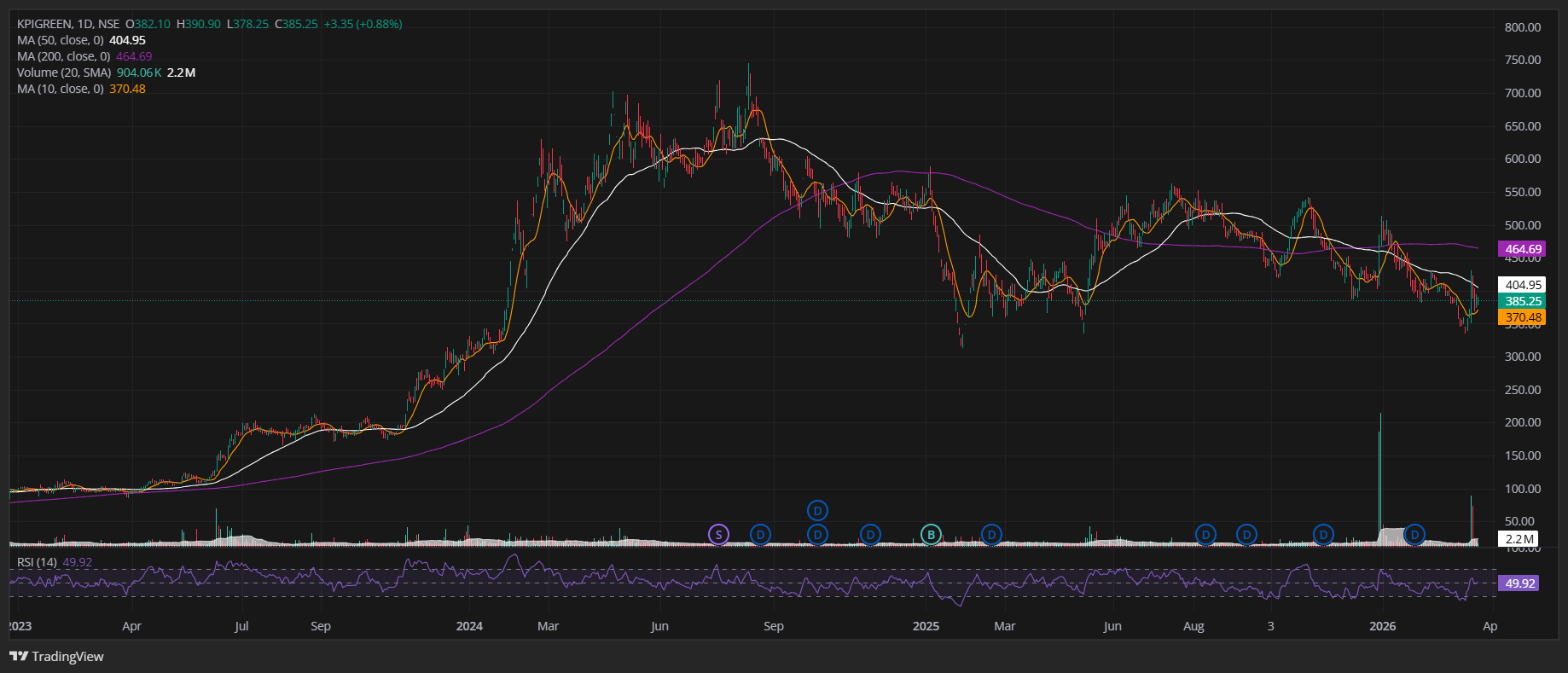
The Setup: The stock has formed a strong bullish base near the ₹380 level, with significant volume participation coming back into the counter over the last few trading sessions.
Key Levels: The immediate near-term support is rock solid at ₹380. If it breaks below this, the next structural support is at ₹335. On the upside, the stock faces immediate resistance at the ₹425 to ₹430 band. A decisive daily close above ₹430 will invalidate the recent downtrend and open up the charts for a target of ₹465 and beyond.
The Dark Side: Fundamental Risks
This is not a “buy and forget” compounding machine. It is a highly cyclical execution play, and you must monitor these three red flags:
The 45% Promoter Pledge: This is the scariest metric. The promoters have pledged roughly 44.9% of their total shareholding to banks as collateral for loans. Because the stock price recently fell from ₹474 to ₹385, the value of that collateral dropped. If the stock crashes further, banks could trigger a “margin call” and forcefully sell those shares, causing a catastrophic freefall.
The Working Capital Trap: Their cash conversion is deteriorating. Over the last year, their working capital cycle stretched from 92 days to over 168 days. Their cash is getting trapped in receivables from government Discoms.
The Interest Burden: In Q3 FY26 alone, their quarterly finance costs (interest payments) skyrocketed by over 230% YoY, hitting ₹48.5 Crores. The heavy debt burden required to execute their 3.6 GW order book is constantly eating into their bottom-line net profit.
KPI Green Energy offers one of the most asymmetric risk-to-reward setups in the Indian market today. You have a company growing EBITDA at 73%, sitting on a 3.6 GW order book, and trading at just 18.5x earnings, backed by ₹64 Crores of pure insider buying.
The catch? You have to stomach the volatility of a 45% promoter pledge and rising debt costs.
For positional investors willing to actively track quarterly cash flows and manage their stop-losses (strictly below the ₹335 structural support), this is a phenomenal high-beta play on India’s renewable energy supercycle.
WANT MORE LIKE THIS?
Join the Inner Circle for weekly deep-dives and live trade calls.
Apply for accessCompound with Raunak is not a SEBI-registered investment adviser. All content published on this platform, including trade calls, research, and analysis, is for educational and informational purposes only. Nothing here constitutes investment advice or a recommendation to buy or sell any security. Readers should consult a qualified financial adviser before making investment decisions. Past performance is not indicative of future results.